
10 Features to Look for in a VDR that Speed Up the Dealmaking Process
10 must-have virtual data room (VDR) features to speed deals: real-time tracking, page analytics, granular permissions, audit trails and integrations.
Discover how biotech companies can safely navigate fundraising - from initial pitch decks to rigorous due diligence, by using secure virtual data rooms to protect clinical data, proprietary IP, and confidential documents while maintaining full control over investor access.
Biotech fundraises start with a pitch deck, but diligence can extend into IP, financial, technical and regulatory information. For each sensitive document, decide who gets access, what they can do with it, how long access lasts, and what visibility you need afterward. Access isn't static — it can expand or tighten as investors move through diligence. A biotech data room like Digify supports granular permissions, print and download controls, dynamic watermarking, access expiry and activity logs to manage that process.
A biotech fundraise can start with a pitch deck and high-level company information shared over email. As investor conversations progress, however, diligence may extend into intellectual property, financial information, technical research, regulatory materials and other confidential information — the point at which many companies start looking at a biotech data room instead of ad hoc file sharing.
That creates a different problem from simply sending investors more files.
The company and its advisors still need to decide what information is appropriate to disclose and when. But once that decision has been made, another set of questions emerges: Who should have access? What should recipients be allowed to do with the information? How long should that access remain available? And what visibility should the company retain after sharing?
Those are information-management decisions, and they become increasingly important as diligence gets deeper.
There is no universal rule for which documents a biotech company should disclose to investors or at what point in a fundraise. Once the company and its advisors decide that sensitive information should be shared, however, the process should make it clear who can access it, what they can do with it, how long that access remains available and what happens after it is shared.
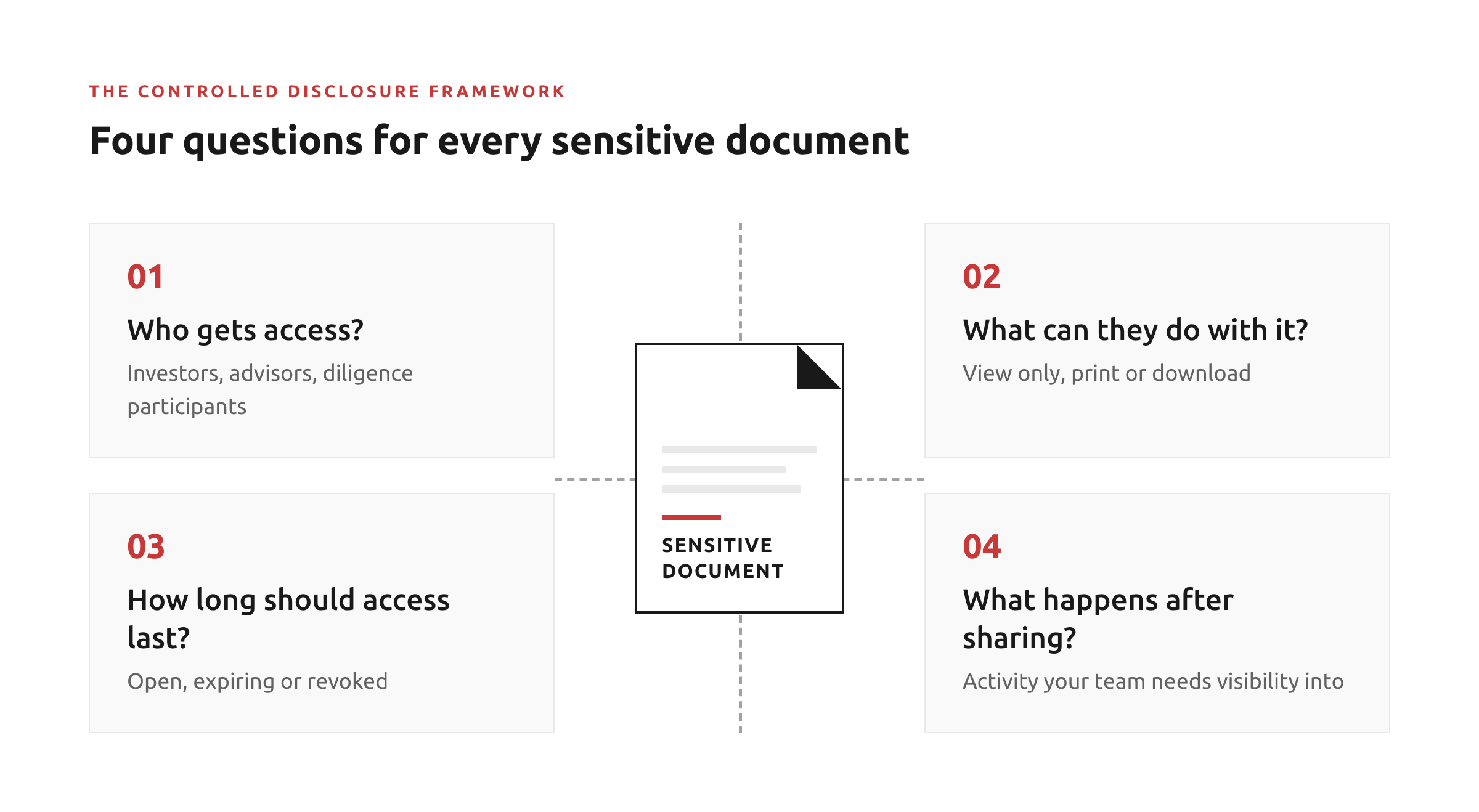
A useful way to think about this is through four questions:
| Question | What you are deciding |
|---|---|
| Who gets access? | Which investors, advisors or diligence participants need the information |
| What can they do with it? | Whether they can only view it, or also print or download it |
| How long should access last? | Whether access should remain open indefinitely, expire or be revoked |
| What happens after sharing? | What activity your team needs visibility into |
This framework does not determine what your company should disclose. Instead, it helps you manage the information after the disclosure decision has been made.
Investor due diligence is not limited to financial statements and corporate records.
The World Intellectual Property Organization (WIPO) describes IP due diligence as an audit of a company's intangible assets — including patents, trade secrets and other intellectual property — that may be conducted by potential investors, partners or buyers when a venture is raising capital. WIPO notes that trade secrets can cover technical information such as manufacturing processes and pharmaceutical test data, provided the information meets the relevant requirements for trade-secret protection.
The implication is not that every biotech company must place the same scientific or IP documents into its investor data room.
It is that a pitch deck, a financial forecast and confidential technical information may carry very different levels of sensitivity. Treating all three with exactly the same sharing settings may therefore make little sense. For a wider look at the pressures shaping this sector, see our guide to biotech fundraising trends, challenges and data security.
The right disclosure strategy will depend on your company. The information controls around that strategy should be just as deliberate.
Data-room advice often starts with folder structures: Corporate, Financial, IP, Regulatory, Clinical, Commercial.
That can be useful for organization, but folders alone do not tell you how information should be handled.
Consider two files in the same folder. One might already contain information that has been widely circulated to prospective investors. Another might contain highly confidential technical details that the company only intends to share with a small group conducting deeper diligence.
Their location might be similar. Their sensitivity might not be.
A better starting point is to ask how sensitive the information is in your specific context.
| Information type | Potential sensitivity | Information-management question |
|---|---|---|
| Public or widely shared company information | Lower | Does this need additional restriction at all? |
| Fundraising material | Moderate | Who should receive it and for how long? |
| Financial information | Higher | Does the recipient need a downloadable copy? |
| IP-related information | Potentially high | Should access be limited to specific recipients? |
| Confidential scientific or technical information | Potentially high | What level of access is appropriate for this recipient? |
These categories are illustrative, not disclosure recommendations. The sensitivity of any particular document and its appropriate treatment should be determined by the company with the relevant internal and professional advisors.
The broader information-security principle is well established. NIST's guidance on information exchanges says information shared between organizations should receive protection commensurate with its risk before, during and after the exchange.
The sharing method should reflect the sensitivity of what is being shared.
Investor diligence is not one event.
A company might initially have conversations with a broad group of prospective investors, then move into more detailed discussions with a smaller set of parties. Specialist advisors or technical diligence participants may become involved. Some investors may leave the process while others request additional information.
That means access does not necessarily need to remain static.
WIPO's 2026 guidance on using virtual data rooms for IP investment specifically recommends need-to-know permissions, expiring invitations, watermarking, and logging downloads and interactions when managing confidential IP information in a VDR.
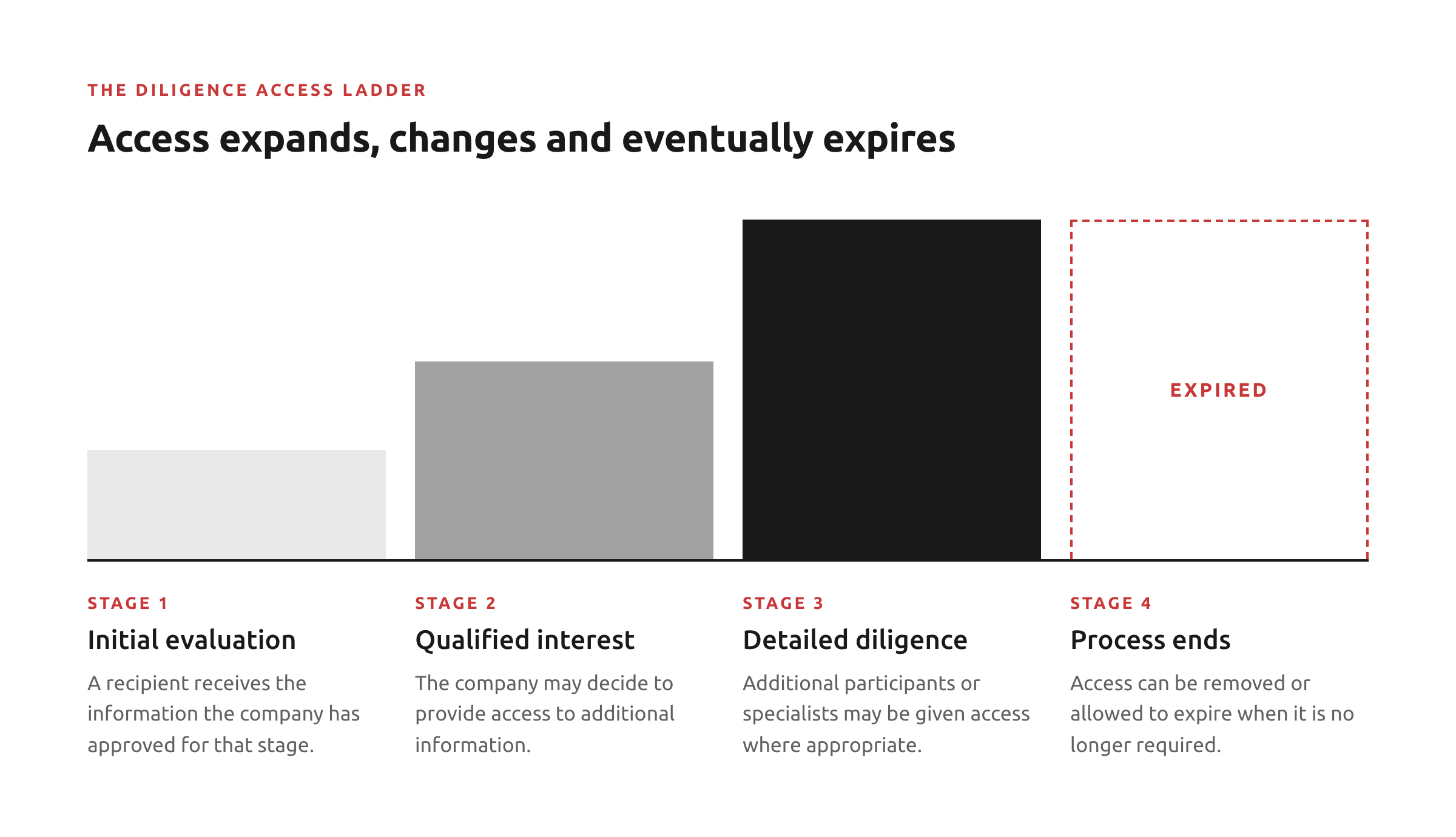
| Stage | What typically happens |
|---|---|
| 1. Initial evaluation | A recipient receives the information the company has approved for that stage. |
| 2. Qualified interest | The company may decide to provide access to additional information. |
| 3. Detailed diligence | Additional participants or specialists may be given access where appropriate. |
| 4. Process ends | Access can be removed or allowed to expire when it is no longer required. |
The useful capability here is not predicting which scientific document belongs at which stage. It is being able to change access without rebuilding the entire sharing process.
Once information has been approved for sharing, the next question is who needs to see it.
Different investors may be at different stages of the process. A prospective investor evaluating the opportunity may not need the same access as a lead investor engaged in detailed diligence. External advisors or specialists may need access to a specific subset of information rather than the whole room.
If your diligence process requires those distinctions, your data room should support them. Digify virtual data rooms support data-room, group and granular permissions, allowing owners to control access for different recipients rather than applying a single permission model to everyone.
The principle is simple:
Access should follow the disclosure decision, not the other way around.
Decide who should receive the information first. Then configure the room accordingly.
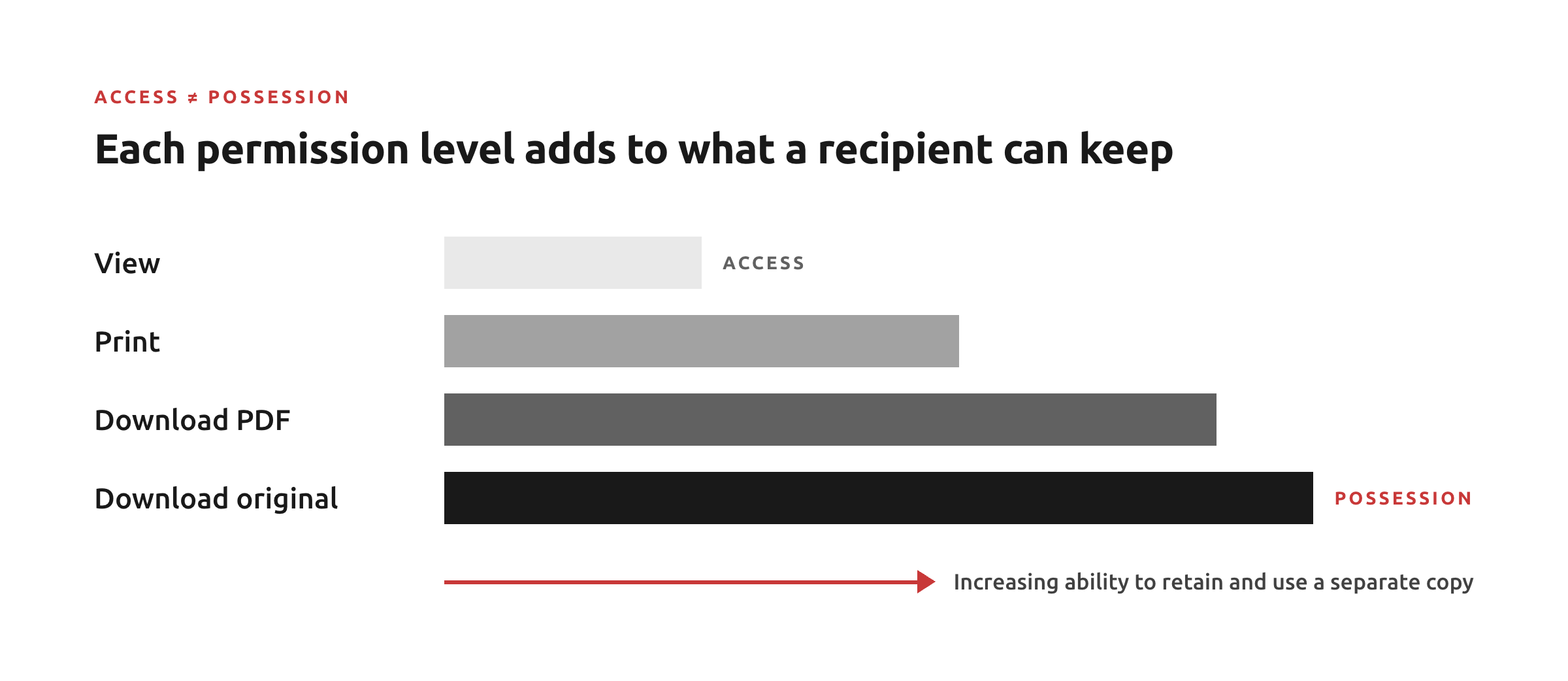
There is an important difference between allowing someone to see a document and allowing them to take a copy away.
For ordinary collaboration, downloading a file may be expected. For more sensitive external sharing, the decision deserves more thought. Ask:
Digify virtual data rooms include print and download permissions alongside granular access controls and dynamic watermarking.
| Permission level | What the recipient can do | Retains a separate copy? |
|---|---|---|
| View | Reviews the document on screen | No |
| Produces a physical copy | Partially | |
| Download PDF | Saves a watermarked PDF copy | Yes |
| Download original | Takes full possession of the file | Fully |
This does not mean downloads are bad. In some situations, recipients may genuinely need them. The more useful question is:
Does this person need to access the information, or do they also need to possess a copy of it?
Those are different decisions.
Fundraising processes change. An investor may decide not to continue. A diligence workstream may finish. An advisor's involvement may end. A document may be superseded by a newer version.
Granting someone access once does not necessarily mean they need it forever. That is why expiry and revocation matter. Digify data rooms support data-room and guest access expiry as part of the platform's permission controls.
The practical approach is to treat access as something that has a lifecycle:
This becomes especially useful when several investors are moving through diligence at different speeds.
Instead of asking "who has ever received this?", your team can ask "who still needs access to this today?"
Document activity can provide useful context during a fundraise, but it needs to be interpreted carefully.
Seeing that an investor opened a document does not prove that they intend to invest. Spending more time on a page does not automatically indicate conviction. Activity data is a signal, not mind-reading. What it can provide is visibility. For example:
Digify data rooms include analytics and an activity log for this purpose. Used appropriately, that information can give your fundraising team additional context when deciding where follow-up may be helpful.
Worth knowing: Analytics can tell you what happened inside the data room. Your team still needs to interpret why.
Case study · Medtech · Singapore
Singapore-based medtech company StratifiCare provides a useful example. The company develops diagnostic technology and owns a patent covering a panel of biomarkers. During fundraising, StratifiCare needed a virtual data room to support potential investors conducting due diligence. Its pitch decks contained sensitive information about its patented technology, so the team wanted to limit access to authorized recipients.
StratifiCare used Digify to maintain updated diligence documents, share its pitch deck securely and monitor engagement. It also used expiry settings when access to confidential documents was no longer required.
The point is not that every biotech or medtech company should copy StratifiCare's exact workflow. It illustrates the underlying pattern: sensitive information is shared, access is controlled, activity provides additional context, and access can end when it is no longer required.
A virtual data room is not automatically necessary the moment a company starts fundraising. For early conversations involving a small number of relatively non-sensitive materials, ordinary file sharing may be sufficient. The need for a VDR becomes stronger as the external-sharing requirements become more demanding.
| Ordinary file sharing may be enough when | A VDR becomes more useful when |
|---|---|
| You are sharing a small number of relatively non-sensitive documents | Increasingly sensitive information enters the process |
| All recipients can receive essentially the same access | Different recipients require different levels of access |
| Controlling downloads is not important | You want some documents to remain view-only |
| Access does not need to change frequently | Access may need to expire or be revoked |
| Detailed activity records are unnecessary | Several investors or diligence participants are involved, and your team needs a clearer record of activity |
Virtual data rooms are commonly used for startup fundraising, buyer/seller due diligence, IP licensing and other workflows involving confidential external information. Digify's VDR supports permissions, group access, print and download controls, dynamic watermarking, analytics and access expiry within that environment.
The dividing line, therefore, is not simply "we are a biotech company, so we need a VDR." A better question is:
Has our diligence process become sensitive or complex enough that ordinary file sharing no longer gives us the control we need?
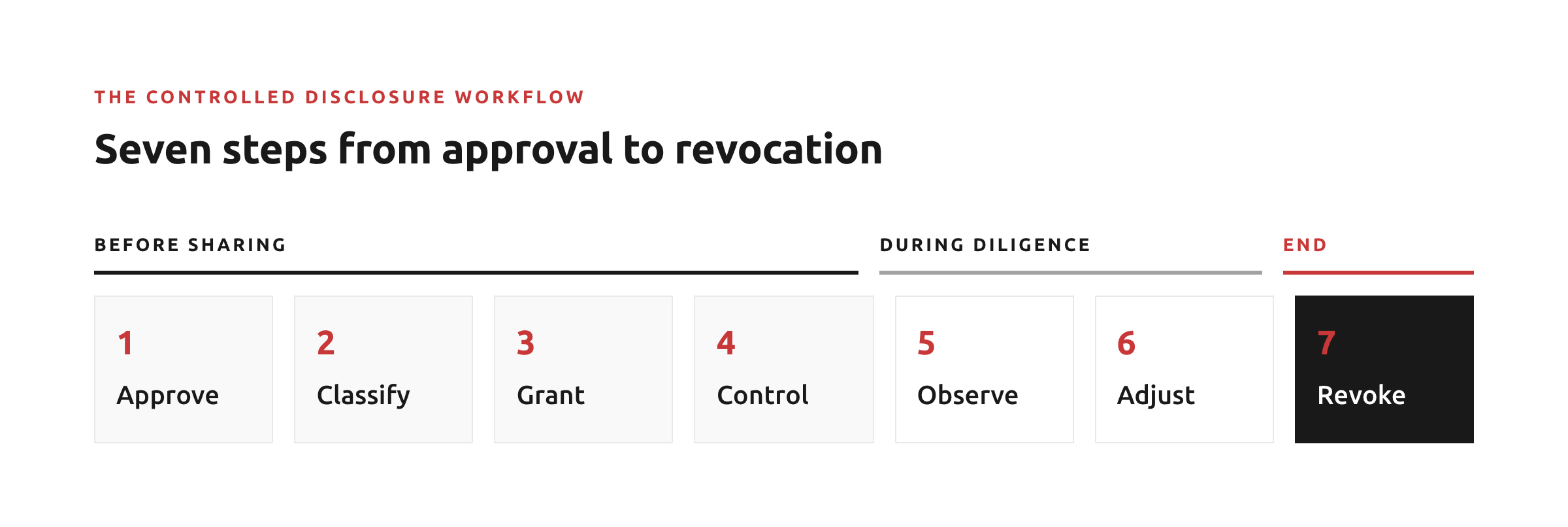
You do not need a complicated framework to apply these ideas. Before sharing a sensitive document, work through these decisions.
Good information control should not prevent investors from doing their work. Investors still need enough information to evaluate the company. Founders still want diligence to move efficiently. Advisors and specialists need access to the materials relevant to their role.
The goal is not to add restrictions for the sake of security. It is to make access deliberate: the right recipient, the appropriate permissions, for as long as access is needed, with enough visibility for the company to understand what happened after sharing.
That becomes increasingly valuable when a biotech fundraise moves beyond the pitch deck and into sensitive IP, scientific, financial or regulatory information. Digify provides a modern virtual data room and secure document-sharing environment for managing those controls, including granular permissions, download restrictions, dynamic watermarking, expiry and activity tracking — without requiring teams to treat every document or recipient the same way.
Control who sees what, for how long, and with what permissions — without adding friction to your fundraise.
Start 7-Day Free TrialA biotech data room is a secure online environment used to share confidential company information with approved external parties, such as investors or advisors. Depending on the company and purpose, the information may include corporate, financial, intellectual-property, technical, regulatory or other materials. The company and its advisors should determine what is appropriate to disclose.
A VDR becomes particularly useful when fundraising starts to involve sensitive information, multiple investors, different access requirements, download restrictions, expiring access or a need for better activity visibility. Early-stage conversations involving only a small number of non-sensitive documents may not require one.
Yes. Digify supports data-room, group and granular permissions, allowing different recipients to be given different levels of access where the diligence process requires it.
Digify allows owners to configure print and download permissions for data-room content. Whether a particular document should be downloadable is a decision for the company based on the information, recipient and diligence requirements.
Access to information in a controlled data-room environment can be changed as the diligence process develops. Digify also supports guest and data-room access expiry.
Digify includes data-room analytics and activity logs that give owners visibility into recipient and document activity. Those signals can help provide context for follow-up, but should not be interpreted as proof that an investor will or will not invest.
Author
Shubham Kulkarni works at the intersection of AI, GTM, and brand visibility. He helps early-stage teams turn expertise into authority across search and AI answers.
10 must-have virtual data room (VDR) features to speed deals: real-time tracking, page analytics, granular permissions, audit trails and integrations.
Discover how AI, ESG, and blockchain tokenization converge with strategies for fundraising in volatile markets to shape the future of private equity.
Learn how to structure fund closes, simplify subscription docs, and set up follow-on fundraising.